
Transitional gross-motor milestones – part 4
Nothing is completely safe, including them, but the experiences learned are the stepping stones for their lifetime of motor choices and experiences. Luckily, a baby’s developing desire to climb is usually matched with their motor ability to do the job. Usually babies learn how to crawl and to pull to stand and start climbing in very close succession.
Climbing demonstrates the baby’s ability to plan and problem solve and how to manage their bodies on unfamiliar, uneven, and unsteady surfaces. It involves coordinating their arms, legs, and body while learning about different surfaces, heights, and depths.
Deb’s Key Takeaways
Skills needed for safe early climbing
- Strength/balance
- Depth perception
- Motor planning
- Learning by practice
Why climbing is important
How to keep young climbers safe
- Have soft mats/cushions in areas they climb.
- Secure or block high furniture.
Ways to help your baby to learn to climb
- Create obstacle courses of cushions, tunnels, solid boxes, and sofa cushions – Even a pool noodle is fun to climb over!
- Demonstrate/play peek-a-boo behind an obstacle.
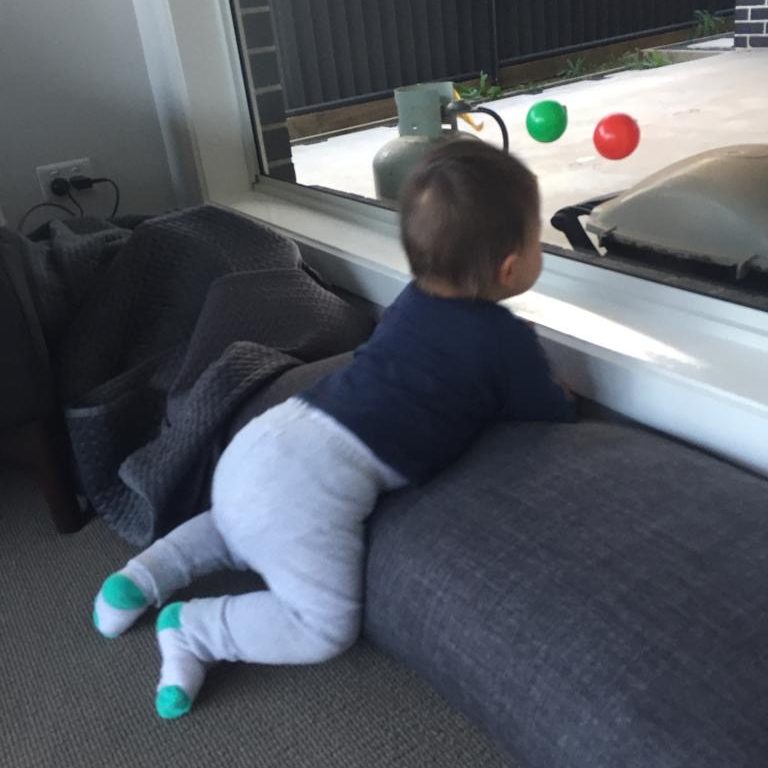
Development of the skills needed for climbing: 8 to 12 months
8-9 Months:
- Stairs, people, and furniture are choices to attempt to climb on.
- Climbing is encouraged by your baby’s wanting to reach toys or objects, but at this age they cannot plan to climb down stairs or off furniture, so they require constant supervision.
- Stair climbing uses the same skills as they used for learning to crawl i.e. moving diagonal sides of the body and coordinating arms and legs.
- In the process of climbing stairs, they practice lots of kneeling and kneeling to stand, therefore joining skills of pulling to stand.
- At 9 months your baby may begin to climb up onto a chair to sit!

10 months
- Your baby will crawl and then climb up/over objects that are in their way to find a toy. This is how they start experiencing unstable surfaces, different heights, and widths when climbing!
- At this age, they start to develop the problem-solving skills of what is safe and what isn’t!
- Motor planning is needed for reaching a toy after climbing to it. Your baby needs to move their body and trunk to sit or stand balanced when reaching for the toy.
- Your baby now looks behind them to lower themselves to sitting on the stairs as their knowledge of depths develops.
- Babies still enjoy stair climbing and love being given opportunities to practice.
11 months
- Climbing is one of your baby’s favourite activities now! Most of your furniture will be seen as a challenge for your baby, so now’s the time to keep a close eye on them.
- The 11-month-old has the motor skills to climb down an object or stairs. They do this by sitting down, rotating themselves around, and then climbing down backwards, feet first. This demands your baby to be aware of where their body is in relation to the furniture – knowing when to let the legs extend and how to hold onto the furniture with their hands!

12 months
- Your baby now has enough leg strength and range to step up onto a step, while holding on with their hands. They can then lift their body up onto the step.
- With their newly learned skill and strength, they can now climb over objects. For instance, into a box or playpen! Happy climbing!
Climbing is important because:
- Climbing is a great way for babies to build strength, flexibility, and balance.
- It is a way for them to learn about their surroundings, depth perception, stability, and height.
- Babies learn how to plan and practice the skills necessary to organise and carry out more and more complex motor tasks.

Ways to help your baby learn to climb
- Create obstacle courses of cushions, tunnels, solid boxes, and sofa cushions – Even a pool noodle is fun to climb over!
- Play peek-a-boo as you hide behind objects.
- Show your baby how to climb under/over objects by doing it yourself.
- If you have stairs, block them off and only let your baby practice on them when you are around.
- By 10-12 months, help your baby turn around and come backwards off couches and stairs.
- You can fill cardboard boxes so they are stable and use as stairs with stools, etc.
How to keep young climbers safe
- Have lots of soft play around to climb on near lounges, etc. – but always supervise.
- Make sure the cot base is low enough so they can’t climb out.
- Pack away objects on high surfaces that they might try to get, e.g. mobile phones.
- Make sure no furniture is near windows and that all windows are properly secured.
- Secure heavy furniture to walls or block off access.

Climbing is a wonderful skill that develops between 8-12 months and continues on into toddlerhood as they become more and more mobile. Early climbing provides your baby with the opportunity to practice balance, motor planning, depth perception, and risk taking. Enjoy your early climber by making their surroundings as safe as possible and by joining in their exploring things and showing them how to climb safely.
Keep safe and well.
Deb