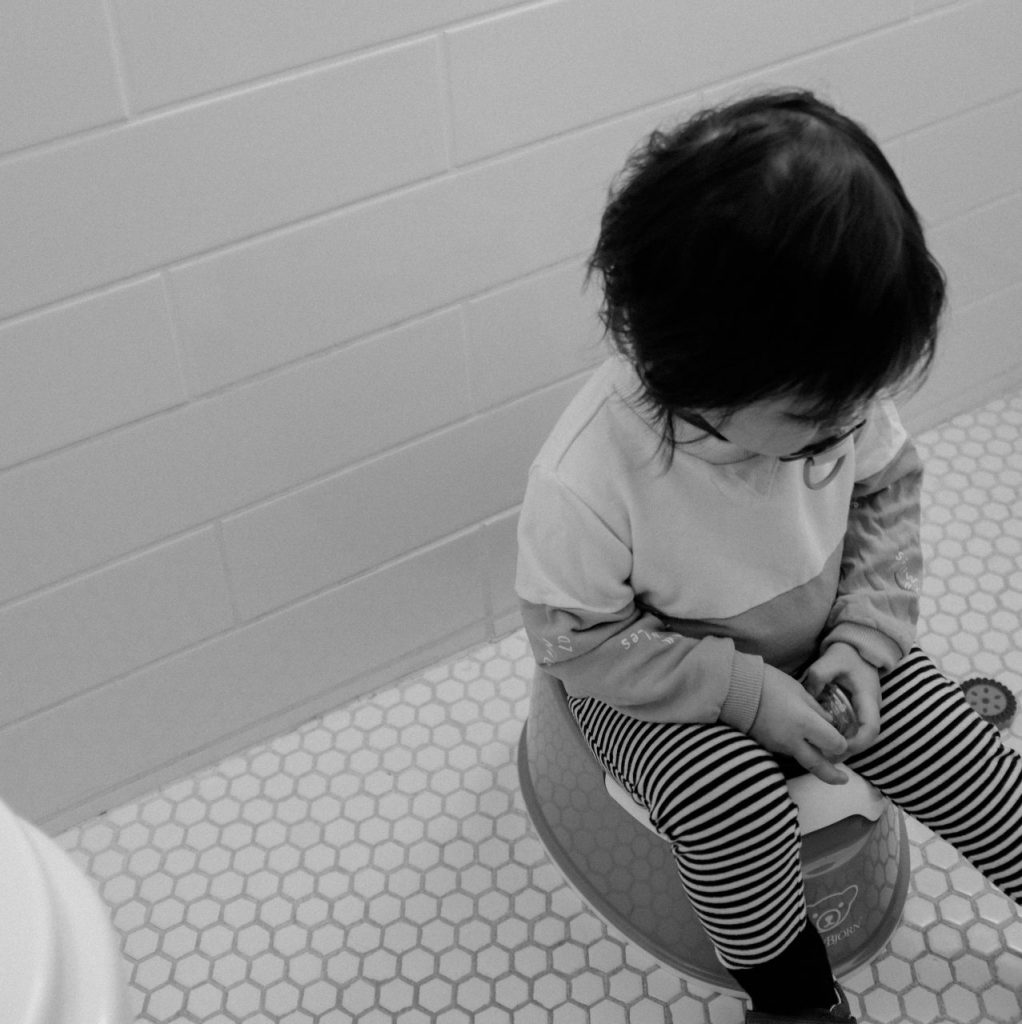
What is crossing the midline?
- It is easiest to think of the midline as an imaginary line down the middle of your child’s body from head to between their feet.
- Your child can reach across the body from their right to left side (and vice versa) when they can cross the midline.

Crossing the midline is important because:
- When children can do this activity, they are using both sides of their brain to coordinate smooth, controlled, complex movement.
- It is important to combine movement patterns that cross the body for daily tasks such as reading, writing, and tying shoelaces.
- It is needed for tasks that involve both hands, where they work together to do a job.
Crossing the midline develops from:
- Babies follow a moving object across the midline from about 4 months.
- They cross the midline to play with their feet by about 6-7 months.
- They will cross the midline on purpose for a toy by 8-12 months.
- This complexity of skills done by crossing the midline increases until 3-4 years of age when they are drawing.
- By school age, when they begin to read, they follow words across a page with their finger/eyes.

Necessary building blocks for crossing the midline:
- Bilateral integration – This is using both sides of the body at the same time.
- Core strength or muscles of the trunk needed to stabilise your child’s body so that they can use their arms and legs with control.
- Trunk rotation
- Hand dominance – this allows advanced movement across the midline for tasks such as writing.
- Planning and sequencing – ability to complete multi-step skills.
- Body awareness/sensation – information from the body’s joints/muscles tell the brain about the body’s position.
If your child has problems crossing the midline you might see:
- Them swap hands when doing activities, e.g. drawing/painting, etc.
- Delayed hand dominance – use their left hand for activities on left and right hand for activities on right, with no crossing over.
- Rotate their body rather than reach across the imaginary midline.
- May have difficulty visually tracking an object – i.e. following text when reading.
- Have difficulty with complex gross motor skills – star jumps, skipping.
- Problems tying shoelaces.
What you can do to help your child to cross the midline:
- Encourage your child to use their two-handed skills, e.g. dressing, catching a ball, threading, riding a bike.
- Help your child strengthen their core – e.g. play row, row, row your boat, do yoga, ride a balance bike.
- Integrate crossing the midline while doing daily activities, e.g. dressing, bathing, etc.

Some activities that you can do with your child to help crossing the midline:
- Craft activities – thread beads, painting, drawing
- Finger puppets – taking on/off taking on/off using other hand
- Playing with stickers – taking stickers off body parts on the right side using the left hand and taking stickers off body parts on the left side using the right hand.
- Musical instruments
- Marching games/yoga
- Twister
- Popping bubbles on opposite of body
When to ask for help:
- If your child is having difficulty with age appropriate skills, i.e. buttons, threading, using scissors.
- If your child has not developed dominance by 3-4 years of age.
- If your child swaps hands when writing/drawing, i.e. cannot cross over the midline with a hand.
- If they have difficulty tracking objects across the midline.
- If they have difficulty with two-handed gross motor skills, e.g. hitting a baseball and other ball skills.

If your child has difficulty with skills involving crossing the midline, i.e. drawing, writing, reading or ball skills, discuss your concerns with your GP, paediatrician, or occupational therapist or physiotherapist.
Stay safe, happy, and well,
Deb