
What is it?
Hypermobility syndrome is a term used to describe overly mobile joints which occurs as a result of the protein collagen being more flexible than usual. Hypermobility varies on a spectrum of different severities, some with more serious complications these include Ehlers Danlos Syndrome and Marfans syndrome. The other end of the spectrum has milder consequences that are not life-threatening such as benign hypermobility joint syndrome (BHJS). The term benign hypermobility joint syndrome (BHJS) is a common source of joint or muscle complaints that often cause concern for parents, children and school personnel. Benign hypermobility describes a child that has several joints that are more flexible than usual. This happens when the connective tissue which makes up the joint structures (capsule and ligaments) is more compliant (easier to stretch) than usual.
Generalised joint hypermobility is quite a common occurrence – in fact, it is just a normal variation in the way joints are put together. Most ballet dancers and gymnasts have a degree of joint hypermobility – which means that you can be hypermobile, strong, active and fit.
What causes generalised joint hypermobility?
The degree of compliance (stretchiness) in connective tissue is genetically determined. Between 10 and 20% of people have connective tissue that is less stiff than usual.
So some degree of joint hypermobility can be viewed as part of the normal variation in the degree of compliance in the connective tissue within the population. However, some experts argue that all joint hypermobility is due to an abnormality in the connective tissue.
Children with generalised joint hypermobility will usually have a parent or other close relative with hypermobility.
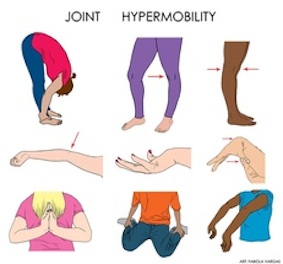
How is generalised joint hypermobility (GJH) diagnosed?
What are the effects of hypermobility syndrome?
- Poor posture/sitting between the legs (W-sitting)
- Muscle weakness and poor endurance
- Pain and fatigue e.g. when handwriting
- Different gross motor development
- Painful joints and muscles which may be acute or chronic
- Movement difficulties both gross motor and fine motor
- Difficulty with prolonged exercise
- A cautious nature (this may be secondary to their movement problems)
- Loose joints - tight muscles (usually around hips and shoulders)
- Flat feet
- More prone to injury
How can physiotherapy help hypermobility syndrome?
- Providing an exercise programme to increase muscle strength and endurance and thus support the joints in individual intervention sessions
- Providing specific arm and hand exercises to increase muscle strength and endurance to lead to improved joint stability
- Assist with core stability and posture
- Advice on gross motor development
- Assistance with attaining higher gross motor skills if difficulties
- Provide advice on and assistance with improving quality and performance of fine motor skills, especially handwriting
- Provide advice on stretches for tight muscles
- Management plan for the integrated use of technology and writing tasks at school
- Advice on shoe wear and/or referral to a Podiatrist if necessary
- Splinting
- Provide advice on types of appropriate exercise and sports
- Advising on appropriate pain management techniques such as the use of heat or ice
- Reducing the risk of injury and persistent pain into adulthood by maintaining muscle strength and good posture with regular posture checks
- Providing advice on reducing factors that may worsen symptoms such as excessive weight
- Provision of a home programme
- Referral to a medical specialist if concerns re the severity of the hypermobility
- Use of adaptive equipment such as pencil grips and built up cutlery handles in order to assist with correct joint positioning and reduce fatigue and pain during activities of daily living
What you can do
All the difficulties associated with BHJS can be improved by an exercise programme that trains muscle strength, endurance and flexibility and teaches the child to take on challenges and to keep going when the going gets tough.
It is as simple as that – targeted fitness training is the key
You can support your child by continuing to offer opportunities to develop strength, stability and endurance through play performed in different surroundings and on different surfaces. exercise in water is beneficial as are activities that promote core strength.