
To develop independent standing, babies require the ability to maintain their balance and posture against gravity while standing just on their 2 little feet – this is called static balance.
The systems that work together to allow this to happen are:
- Vision – the use of eyes to stabilise the body in an upright position (vision account for 10% of sensory system required for balance.)
- Proprioception – this is information the body gathers from the ligaments, muscles, and joints of the baby’s body and is used by the brain to adjust the body to stay upright (70% of info needed).
- Vestibular system – system for posture and balance located in the ears (accounts for 20% of info needed).
All three systems need to work together to allow the baby to easily maintain an upright position stably and automatically.

Motor development needed to stand independently requires:
- Motor coordination: This is the ability to control a number of different muscles at once so that they can act together (e.g. hip/tummy and back muscles all work together to keep a baby’s trunk upright in standing).
- Muscle and ligament strength and joint stability: Babies need to develop strength and length in their muscles to allow them to stabilise their joints for standing (e.g. the muscles and ligaments of the ankle allow a baby to control their foot position in standing).
- Postural reactions: These are the motor and sensory reactions a baby develops in the first year of life to allow the development of functional gross motor skills (e.g. standing and walking). They include reflexes – the automatic movement of babies usually initiated by sensory stimulation. We see a standing reflex in babies in just the first few weeks.
- Righting reactions: This supports the vertical head position and alignment of head and trunk.
- Equilibrium reactions: Move xxx allows the baby to balance when their centre of gravity is challenged.
- Protective reactions: Reactions of hands and feet to prevent injury if the baby can’t maintain their balance.
Cognitive/Social Development
For babies to stand independently they need the desire to be upright to solve problems (e.g. how to use furniture to get up to get a toy out of reach). They also need the confidence to take a risk and plan how to achieve the position. This comes together with the development of their motor and sensory skills.
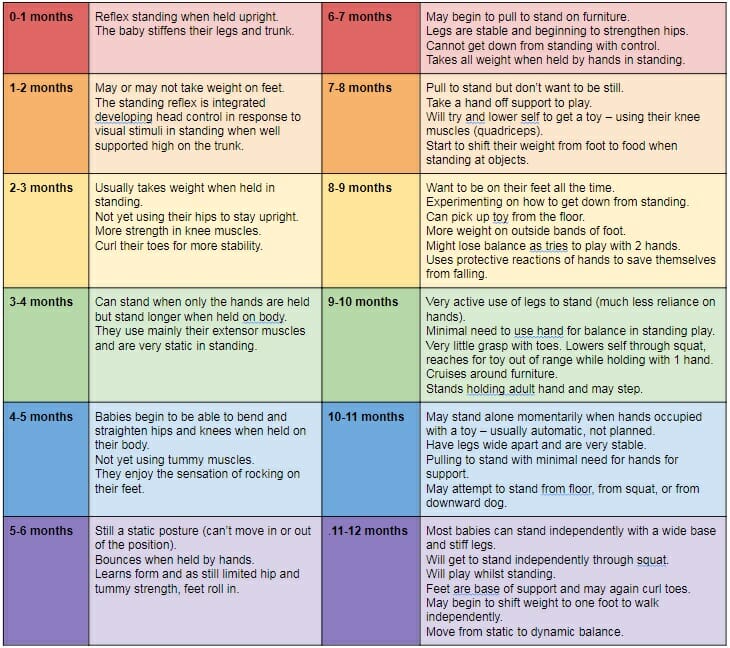
Motor development of standing 0-12 months
Why independent standing is important:
Once a baby can stand alone and balance (static balance) they are then able to develop the ability to shift their weight in standing and develop the ability to walk independently. The development of standing involves both motor and sensory systems working together to provide a stable base for play with 2 hands in an upright position.
Ways to help develop independent standing:
- From birth put your baby on their feet.
- As they develop strength in their legs by 6 months start to hold their hands in standing.
- Put toys up once they are beginning to pull to stand.
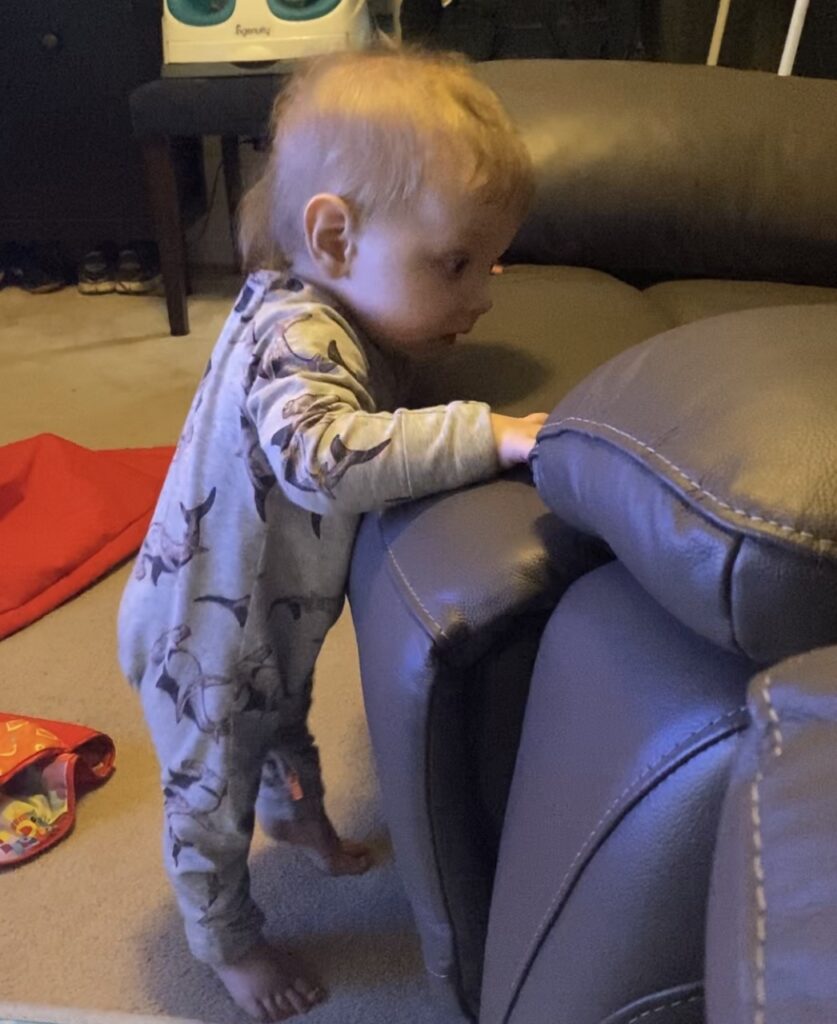
- Put them on their feet to play at the couch by 6-7 months (while ensuring you are there to hold as needed).
- Give them lots of different surfaces to stand on to allow them to develop balance reactions.
- Play lots of games/songs in standing.
- Tip them side to side in standing from 3-6 months to develop head righting reactions.
- Encourage them to reach with one hand in all directions from 8-10 months.
- Help them get from squatting to standing with hands held.
- Encourage play with 2 hands in standing as their balance develops while you hold at their hips.
- Don’t use containers to stand in.
- Tip them forward and back holding at hands from 8 months.
Things that may affect or delay the development of independent standing:
- Difficulties with vision.
- Ear infection may affect their vestibular system (balance).
- Low muscle tone or weakness in developing trunk and leg muscles.
- Loose ligaments around joints (i.e. hypermobility).
- Delays in developing balance reactions in trunk and head.
- Poor saving reactions in hands thus develops fear of falling in standing.
- Delays in cognition and desire to explore/look for toys out of reach.
When to ask for help
Babies all develop motor skills at different times and often in different order but there are some things to look for.
- If your baby is not taking weight when held in standing by 6 months.
- If not pulling to stand by 8 months.
- If their feet roll in or out or they stand on their toes in standing.
- If they can’t catch themselves if they fall in standing from 8 months.
- If they are not standing alone by 13-15 months.
- If they show floppiness or tightness in their leg muscles.
Ways to keep your baby safe in learning to stand
- Provide soft furniture to pull to stand on.
- Watch them if standing on hard surfaces.
- Provide soft surfaces to stand on (e.g. carpet or use foam mats).
- Show them how to fall onto their hands by playing games with them.

Independent standing is a major milestone in a baby’s gross motor development. Allow play while upright with toys with 2 hands from the floor in preparation to carrying objects in walking. It is a complex skill dependent on both the motor and sensory systems. If you have any concerns, contact your GP, paediatrician, or paediatric physiotherapist.
Keep safe, happy, and well,
Deb