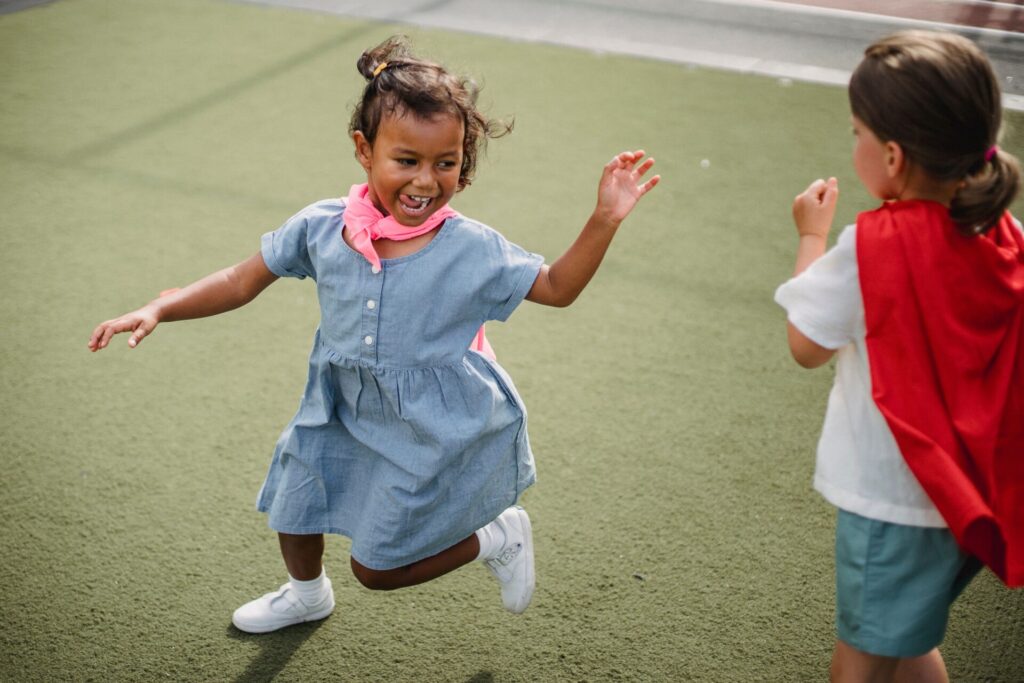
These are the school readiness skills that help a child feel like they belong. So in this second part, we’re heading out to the playground. We’ll look at big body movements, talking and listening, and friendships, with plenty of fun ideas to try over the summer holidays.
Why do big movements matter so much at school?
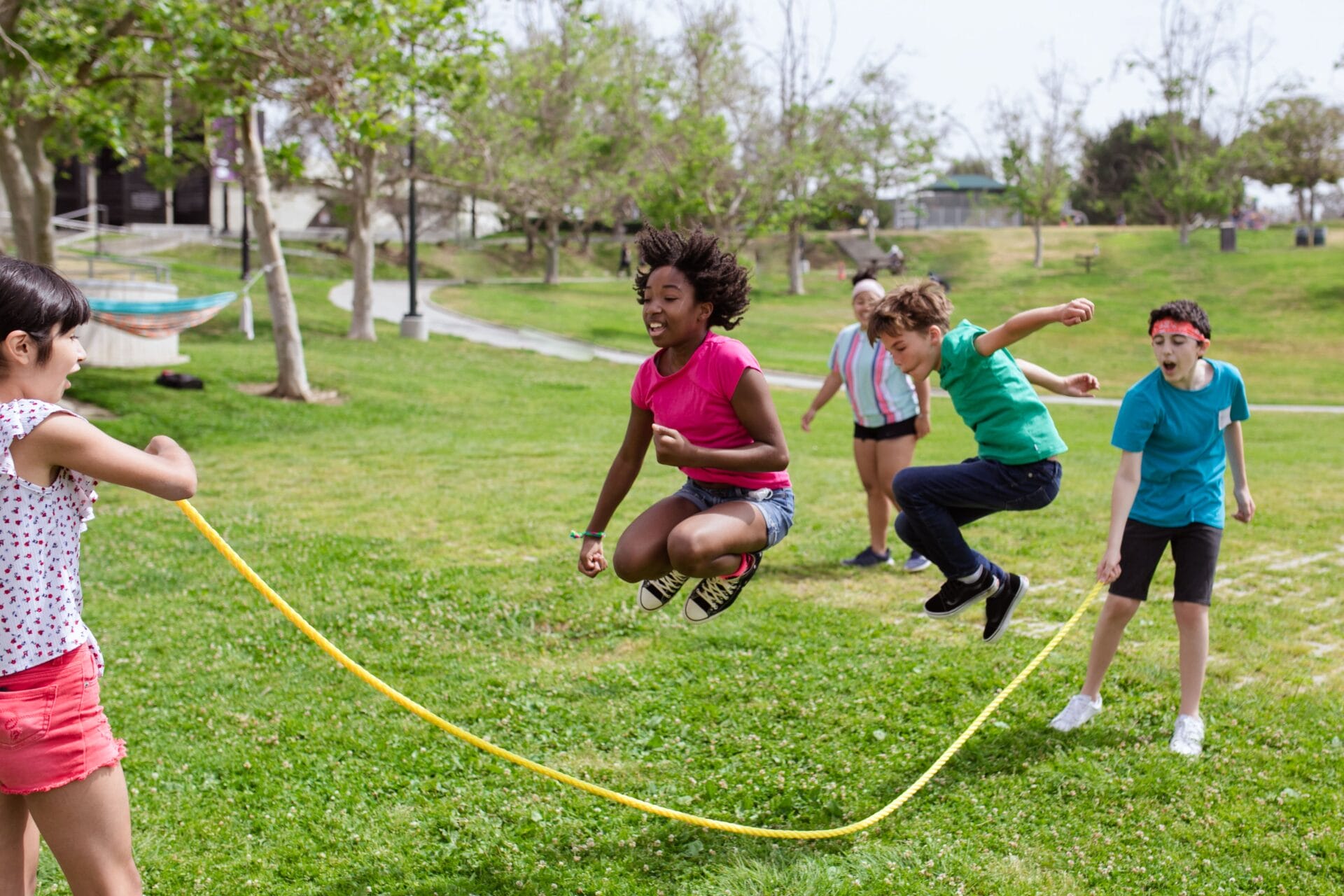
Gross motor skills are the big movements of the body: running, jumping, climbing, balancing and ball games. They help children keep up in the playground, join in with sport and PE, sit well on the mat, and manage stairs and play equipment safely. Children starting school are usually working on:
- jumping over a small hurdle
- hopping and beginning to skip
- climbing stairs on their own, one foot per step
- balancing on one foot
- catching a medium-sized ball (about 16cm) with their hands from around 1.5 metres
- throwing underarm, and beginning to throw overarm
- kicking a ball, which also needs good balance on one leg
How can we practise ball skills at home?
Catching
Start with something soft and slow, like a balloon or a large soft ball. I teach children to make “snappy crocodile hands” to catch it. Then try:
- rolling a ball towards them to stop and pick up
- dropping a large ball and catching it on the upward bounce
These games are also wonderful for visual tracking, which is the ability of our eyes to follow a moving object. That same skill helps later with reading and copying from the board.
Throwing
Throw rolled-up socks, soft toys or small balls at a target. Draw a shape on the pavement with chalk, or use a pillow or bucket to aim at.
Kicking
Build a stack of blocks and kick down the top block, then progress to kicking a large ball.
Why do these games matter for friendships too?
Ball games and simple races aren’t just about motor skills. They’re just as important for social skills, which children need every day at school:
- sharing and taking turns
- interacting back and forth in a game
- coping when they lose, or when the rules change
Learning to lose a game at home, with someone who loves them, is a great rehearsal for the playground. Play simple board games, card games like Snap, and turn-taking games, and gently model being a good sport yourself (“Oh no, I lost! Never mind, let’s play again”).
What about talking and listening?
School relies heavily on language: following instructions, asking for help, making friends and, later, learning to read.
Speech (how your child says sounds)
By the time they start school, most children are easily understood by people who don’t know them. Some sounds take longer to develop, and that’s completely normal:
- a lisp (tongue poking between the teeth on “s” and “z”) is common until about 4½ years, but is unlikely to resolve on its own after that
- “r” can be tricky until about 5 years (“wed” for “red”)
- “th” can be tricky until about 7 years (“fin” for “thin”)
Language (understanding and using words)
Children starting school are usually:
- following two- or three-step instructions
- speaking in complete sentences
- asking and answering who, what, where, when and why questions
- telling a simple story in order
- recalling characters and events from a short story
Pre-literacy (the building blocks of reading)
These include enjoying books, singing the alphabet, recognising some letters, clapping the syllables in words (“hel-i-cop-ter”), rhyming, and hearing the first sound in a word (“sun starts with s”).
How can we build language at home?
- Read together every day, and pause to ask “What do you think will happen next?” or “Who was in the story?”
- Play “I Spy” with first sounds: “I spy something that starts with b.”
- Clap names and words into syllables, and make up silly rhymes (“cat, hat, splat!”).
- Simon Says with two- and three-step instructions: “Simon says touch your nose, then jump twice.”
- Talk about the day at dinner or in the car: who did you play with, what did you do, where did you go?
- Wait and listen. Give your child time to answer before jumping in. Our speech pathologists use the Hanen approach, which is all about building language through everyday moments.
What's reasonable to expect by January, and what isn't?
Every child develops at their own pace, and starting school is a beginning, not a test. Here’s a general guide.
|
Skill area |
Reasonable to expect by Term 1 |
More advanced, comes later |
Worth a chat with us |
|
Movement and balance |
Hops, climbs stairs alone, balances briefly on one foot |
Skipping smoothly; balancing for longer |
Falls often; avoids playground equipment; tires very quickly |
|
Ball skills |
Catches a large ball, kicks a ball, throws underarm |
Catching small balls; overarm throwing |
Avoids ball games; can’t catch a large ball rolled to them |
|
Speech |
Understood by unfamiliar adults |
“r” and “th” sounds |
Hard to understand; a lisp after 4½ years |
|
Language |
Follows two-step instructions; speaks in sentences; asks and answers questions |
Telling longer stories in order |
Difficulty following simple instructions; mostly short phrases |
|
Social |
Takes turns with support; plays alongside and with other children |
Coping with losing every time |
Rarely plays with other children |
When is it worth having a chat with a speech pathologist?
A quick conversation with one of our speech pathologists before Term 1 could help if your child:
- is hard for unfamiliar people to understand
- still has a lisp after 4½ years
- stutters, or gets stuck on words in a way that frustrates or worries them
- has trouble following simple instructions, or often seems not to understand
- mostly uses short phrases, or gets frustrated trying to tell you things
- finds it hard to join in, take turns or play with other children
When is it worth having a chat with a speech pathologist?
A chat with one of our physiotherapists could help if your child:
- trips or falls much more often than other children their age
- avoids the playground, climbing equipment or ball games
- finds stairs difficult, or tires very quickly when running and playing
- seems to favour one side of their body, or walks on their toes a lot
- complains of pain in their legs, feet or back during or after play
As always, your child’s preschool or daycare teacher is a great person to ask, and if anything at orientation left you with a nagging worry, trust that feeling. It’s so much easier to get support in place before school starts than to play catch-up once Term 1 is under way.
How can Therapies for Kids help?
Our speech pathologists, physiotherapists and occupational therapists work together with families, preschools and schools to help children start school feeling capable, confident and ready to make friends. We can assess your child’s strengths, set goals with you, and give you practical, fun strategies to use at home.
Acknowledgement
This blog was developed with input from our occupational therapists and speech pathologists, drawing on resources our team prepared together.
Written by Deb Evans, CEO and Clinical Director, Therapies for Kids. This blog provides general information only and is not a substitute for individual assessment and advice from a qualified health professional.