Transitional gross-motor milestones – part 3
Deb’s Key Takeaways
- Sit to stand
- All fours to kneeling position
- Kneeling to half kneeling
- Half kneeling to stand
- Lots of experience playing in all fours.
- Move your baby’s toys up onto higher surfaces.
- Play with them in kneeling.
- Encourage their efforts even when they find it very hard.
- Make the play space safe.
7 – 8 months – Pulling up to knees/standing on carer/using furniture:
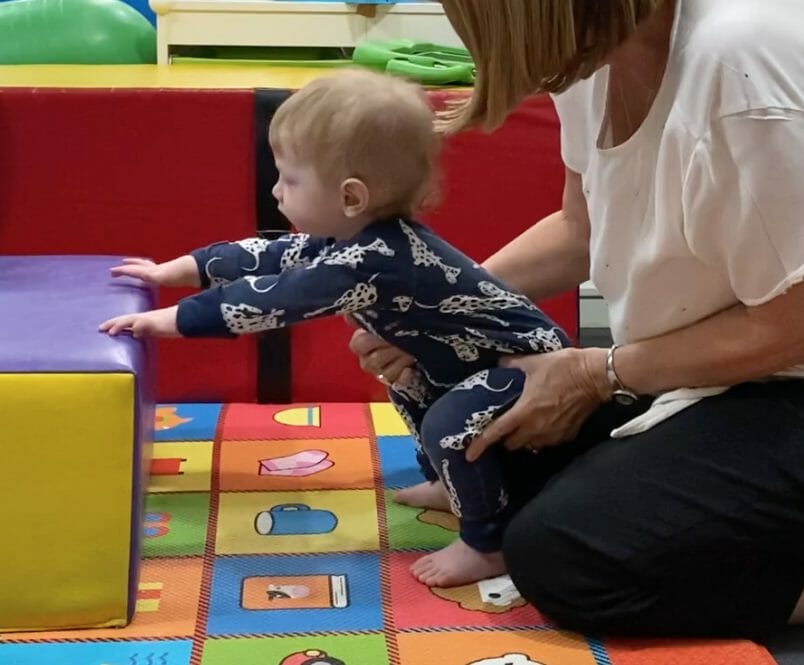
- By the seventh month many babies are beginning to make the change to stand by pulling up onto furniture and people. By eight months their wish to be upright is very strong!
- They often pull up on your clothes from a sitting position on your lap.
- From the crawling position, your baby will stabilise their legs and lower trunk, allowing them to lift their hands up onto the furniture.
- Once their arms are stable, your baby will push/pull with their arms to go onto their knees or to stand up using both legs. Their arms tend to do most of the work in this early stage.
- Their legs provide more help during the eighth month.

8 – 10 months – kneeling/half-kneeling:
- Kneeling and half kneeling (one leg up in front) happen naturally in the movement to stand on furniture. At first, your baby’s bottom muscles (hip extensors) are not strong and so your baby uses their hands, a wide base of support with their legs, and their tummy and hip flexors to pull up.
- At 9-10 months, your baby may start to kneel without hand support, and play in this position as they get stronger bottom (gluteal) muscles.

10 – 11 months – increasing maturity and strength in pulling to stand:
- Babies use a variety of positions to pull up to stand from this age.
- They begin to use half-kneeling, which is a complex motor movement needing a lot of single leg balance and strength.
- By 10 months your baby will begin to play in a half-kneel position and by 11 months your baby can pull to stand easily from here.
- It’s harder to get down and sometimes they get stuck or plonk on their bottoms.

11 – 12 months – squat to stand using furniture/carer for support:
- Some babies will begin to transition to a squatting position for play!
- From a standing position at furniture your baby will begin to lower to a squat and rise again without difficulty.

Pull to stand is important because:
- Kneeling is a wonderful, functional exercise to gain strength and stability in your baby’s bottom/legs and tummy muscles.
- Half-kneeling is a stepping stone to walking while your baby learns single leg balance and strength.
- Pull to stand allows your baby to explore the world off the floor in an upright position It’s a stepping stone to cruising and walking.
Pull to stand is a skill! Practice makes perfect.
How to encourage your baby to move from the floor to standing:
- Give them lots of opportunities to play in all fours/kneel at low objects.
- Put toys up on higher surfaces to encourage pulling up from all fours/encourage crawling to higher surfaces in games.
- Get them to pull up from your lap/low stool onto you/the couch, etc.
- Place toys on a low surface such as a toy box or stable couch cushions and encourage your baby to crawl and pull up to the surface into kneeling. Encourage your baby to get into the kneeling position themselves on furniture/low tables with rounded corners.
- Change the height of the surface – the higher the surface, the more your baby will be encouraged to half kneel.
- From the kneeling position, help your baby bring their foot forward to half kneel, by shifting their weight to one leg.
- Encourage getting down/landing on bottom with “uh-ohs” and lots of smiles! Your baby will learn it is okay to take a risk, make mistakes, and try again! Lots of toys/smiles/games and praise for wanting to do something.
- Encourage early knee bends/squats to pick up toys.
- Provide a place to play that they are safe in, as babies do fall while finding their feet.
What to do if your baby doesn’t pull to stand by 12 months:
All babies have their own individual time-frame for moving onto new skills and doing things on their own, but sometimes babies may get stuck in sitting or move on their bottom (scoot) instead of crawling. This can make it hard for them to plan the movement from sitting to an all-fours position, to kneeling, and then to standing. Some babies are watchers more than movers. They may be focusing on learning language or new play skills and may need more encouragement/play to get them moving up onto their feet. If you have tried the suggestions to encourage your baby to pull into kneeling then standing and they are still having trouble learning the skill, then contact your GP, paediatrician, or a paediatric physiotherapist.
Pulling up into kneeling and onto their feet is the first step towards your baby’s adventure into being an upright mover. It is a transition movement (moving from one position to another) and needs strength, balance, motor planning, and risk taking. Enjoy!
Keep well safe and happy
Deb