Skipping can take some children longer to master, and that makes sense. It’s a complex skill that needs balance, coordination of both sides of the body, rhythm, timing and motor planning, all working together.
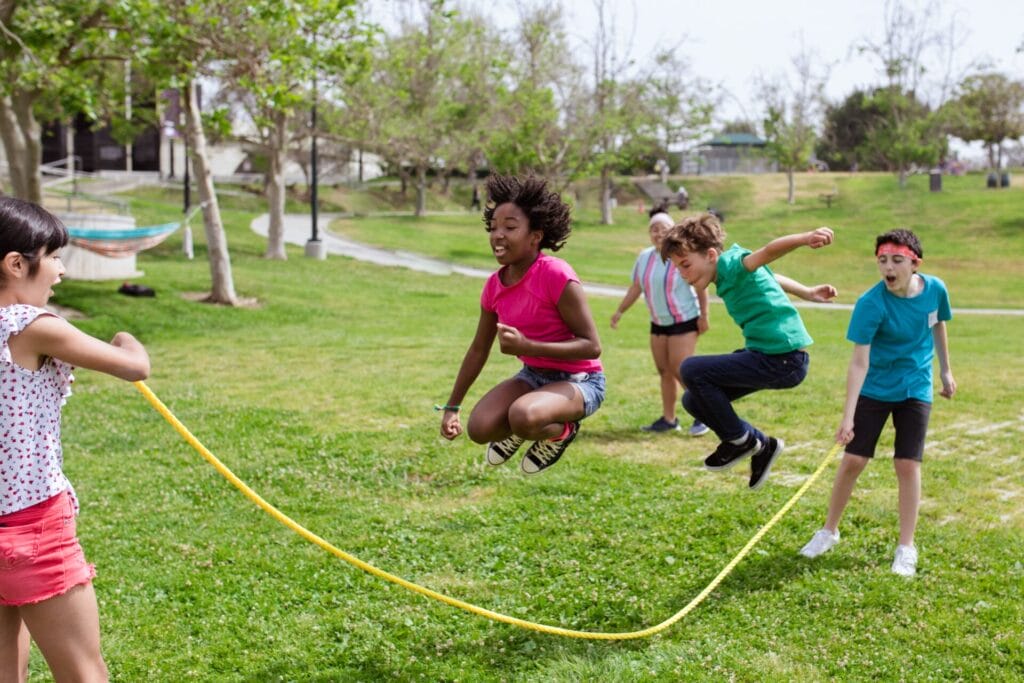
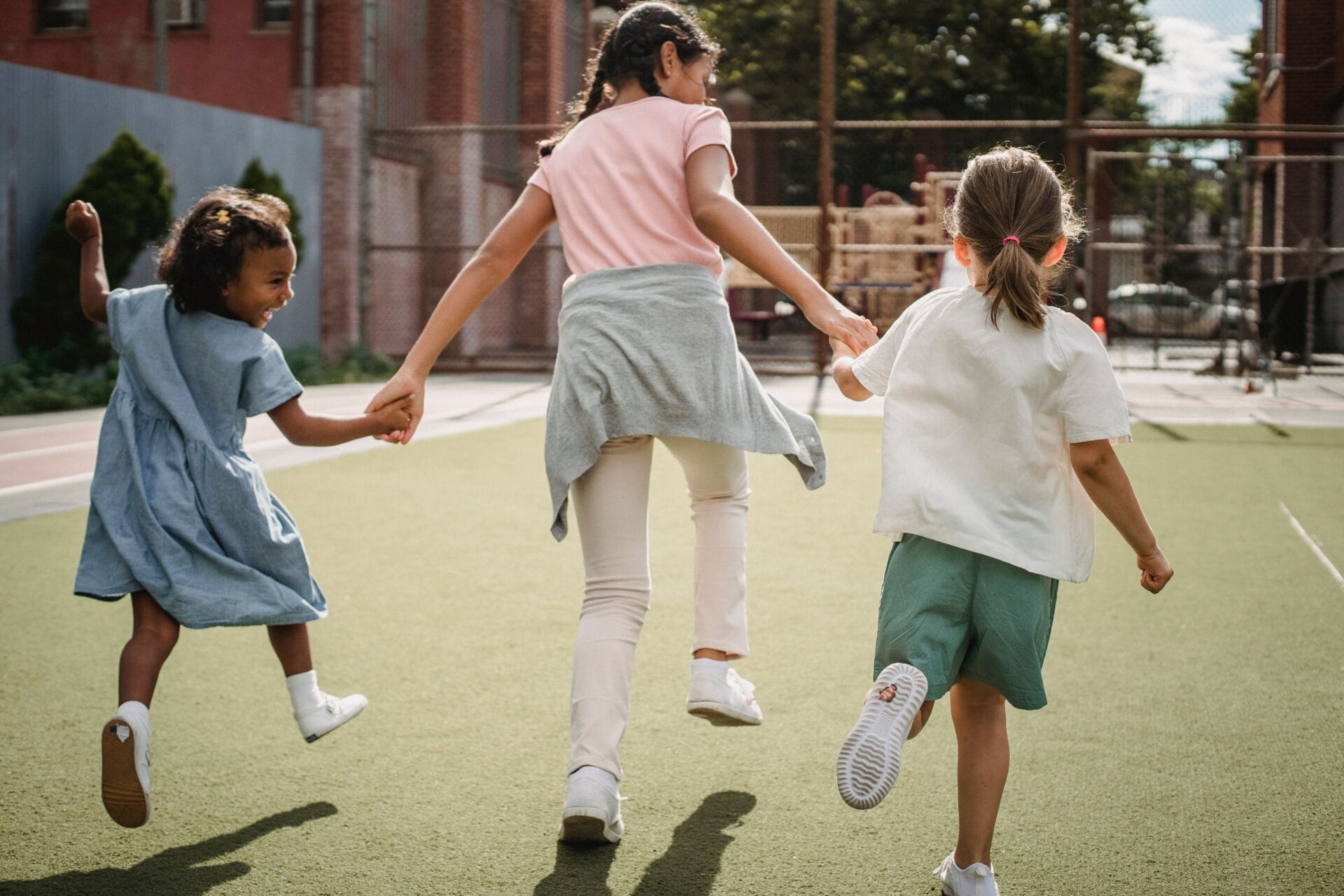
As therapists, we look for skipping to be present around the time children start school. Skipping, along with coordinated hopping and jumping, is part of the foundation for activities like athletics, basketball, dance and gymnastics. If a child can’t yet jump, hop or skip by the time they start school, it may affect how they join in with playground games, and those games are so important for connecting with their peers.
In this blog, I’ll explore:
- What skills are needed for skipping
- When skipping appears, and the milestones that lead up to it
- Why skipping is important for a developing brain and body
- Signs your child may be finding it difficult
- When to seek support, and how therapy can help
- What you can do at home
When does skipping appear?
Skipping is a gross motor milestone that usually appears around five years of age, with a typical range of four to six years. Early skipping is often a little lopsided, and it smooths out with time and practice.
Skipping also keeps refining well past six. Children generally continue to polish their speed, rhythm and control through the early primary years.
What skills does my child need to skip?
A skip is a step and then a hop on the same foot, followed by a step and hop on the other foot, repeated in a rhythm. To skip successfully, a child needs to be able to:
- Hop on one leg while the other leg moves forward. This is a complex movement, with both sides of the body doing different things at the same time.
- Move their arms and legs in opposition. As the right leg comes forward, the left arm swings forward, just as it does when we walk or march.
- Use bilateral coordination. This is the brain’s ability to process and integrate information from both of its sides, so the body moves in a smooth, coordinated way.
- Land on the front of the foot. Soft landings through the balls of the feet give the spring for the next step.
- Keep a consistent step length. Even steps keep the pattern flowing.
- Move rhythmically. Step-hop, step-hop has a beat, and the body needs to keep it.
What are the milestones that lead to skipping?
Skipping builds on balance, hopping and galloping. Here’s a general guide to how those skills usually develop.
| Age | What we typically see |
| 2 years | May start to balance on one leg for 1 to 2 seconds |
| 2.5 years | Attempts to hop, but often can’t get the foot off the ground |
| 3 years | Can briefly stand on one foot and may manage one hop; starting to try galloping, with one foot leading |
| 4 years | Can hop 2 to 3 times on one foot with support; gallops well |
| 5 years | Early skipping, often with a dominant leg doing most of the step-hop |
| 6 years | Skips well, with arms integrated and weight moving forward; can change direction |
Every child is different, and motor skills develop across a spectrum. These ages are a guide, not a test.
Why is skipping important for a developing brain and body?
Just like hopping, skipping is so much more than a fun trick. Because it asks so many systems to work together, it gives a growing brain and body a wonderful workout.
- Both sides of the brain working together. Every skip asks the left and right sides of the body to take turns and cooperate, so the two sides of the brain need to communicate quickly and smoothly. That same bilateral coordination is used for riding a bike, swimming and climbing, and even for everyday tasks like cutting with scissors, where one hand holds and the other cuts.
- Motor planning. Sequencing step, hop, swap sides, and then adjusting on the fly to speed up, slow down or turn, is a big planning job for the brain. Children who find motor planning tricky often show it first in skills like skipping.
- Proprioception (body awareness). Muscles and joints constantly tell the brain where the legs are and how hard they’re pushing. Skipping strengthens that feedback loop, helping children judge force and control their movement.
- Balance. Each hop is a brief moment on one leg. The vestibular (inner ear) system and the postural muscles work hard to keep the body upright while it travels forward.
- Rhythm and timing. Skipping has a beat. Practising it helps children organise their movement in time, which they’ll use again in dance, music, ball games and, yes, skipping rope.
- Strength and endurance. Pushing off through the calves and hips, with a steady core underneath, builds the stamina children need for longer bursts of active play.
- Confidence and connection. Skipping turns up in so many games, chasey, dancing, sport and make-believe. When children can join in, they feel capable, and that confidence carries over into the classroom and beyond.
What are the signs my child may be finding skipping difficult?
- Difficulty balancing on one leg
- Poor push-off, with feet barely leaving the ground
- Falling or tripping frequently
- Tiring quickly
- Not integrating both legs, so one leg stays dominant and they gallop with the same foot leading instead of alternating
- Poor dissociation of the arms, with arms held stiffly, out to the side, or moving with the legs rather than in opposition
- Landing flat-footed or heel first
- Uneven, stop-start rhythm
- Watching their feet the whole time
- Avoiding skipping games, or saying “I can’t”
One of these on its own isn’t a cause for worry. It’s the overall picture, and how your child feels about moving, that tells us the most.
When should I seek support?
You may like to have your child assessed if they:
- Become frustrated or upset when they try to skip
- Can’t hop at all by four
- Aren’t keeping up with their peers in the playground
- Aren’t skipping by around six, or are still galloping with one leg leading
- Move noticeably differently on one side compared to the other
- Trip or fall more often than other children their age
- Tire quickly in physical play
- Are missing other milestones, or their teacher has raised concerns about coordination
A physiotherapist or occupational therapist will look underneath the skip itself, at balance, strength, bilateral coordination, motor planning and confidence. From there, we break skipping into small steps and build it back up through play, so your child gets lots of success along the way.
What can we do at home?
- Hopping games. Hopscotch, hopping between “lily pads,” or hopping to music, on both legs.
- Walking on tiptoes. Sneak like a mouse. This builds push-off and practises landing on the front of the foot.
- Marching. Big arm swings with arms and legs in opposition. Put on some music and march around the house.
- Galloping on either leg. Be horses, and remember to swap the lead leg.
- Use words. Say “step-hop, step-hop” out loud together, slowly at first, then a little faster.
- Stepping spots. Chalk dots or paper plates on the ground, with a step-hop on each one.
- Skip together. Hold hands and skip side by side, so your child can feel the rhythm with you.
Keep it short, playful and fun, and always finish on a win.
Final thoughts
Skipping is one of my favourite milestones to watch. In all my years working with children, I’ve never tired of seeing a child’s face light up the first time step-hop, step-hop finally clicks. It’s such a joyful moment, and it tells us so much about how beautifully their brain and body are learning to work together.
If your child isn’t there yet, that’s okay. Every child learns at their own pace, and with practice, encouragement and the right support, they will keep growing.
If you have any concerns about your child’s skipping or gross motor development, our team is here to help.
- Physiotherapy
- Occupational Therapy
- Intensive Therapy Programs
- Child-led, play-based, goal-focused support
Enquire online or call us on (02) 9519 0966 for more information.
Let's work together to help your child reach their potential, one skip at a time.
Stay safe, happy and well,
Deb.
This article is general in nature and does not replace individual clinical assessment. Milestone ranges vary between sources and between children. If you have specific concerns about your child's development, please speak with a qualified physiotherapist, occupational therapist or your GP.
Acknowledgement
This article was developed for Deb’s Blog and is based on the clinical expertise, whose evidence-informed insights and detailed review helped ensure the content reflects current best practice in speech pathology.
References
The Royal Children’s Hospital Melbourne, Kids Health Info: https://www.rch.org.au/kidsinfo/
Raising Children Network (Australia), Physical development: https://raisingchildren.net.au
Australian Physiotherapy Association, Paediatric physiotherapy: https://australian.physio